skip to main |
skip to sidebar
After leaving Bcharre in Lebanon. we headed back to Tripoli then took the only transport option available to Lattakia in Syria – a service taxi with a couple of local chaps. The border crossing out of Lebanon was straightforward and easy but we were the only westerners crossing at the time and our passports were examined closely, but more out of curiosity than anything else. It was a tiny border crossing with mainly local folk passing through and it was nice to have the two border posts so close together, a matter of a few hundred meters rather than the 3km between Jordan and Israel for eg.
Just before the border crossing there was a town by the sea that had been completely bombed out. A mass of tangled ugly twisted concrete was all that was left. We were unable to find out what it was or why it was devastated as no-one around spoke English (and obviously our Arabic is minimal).

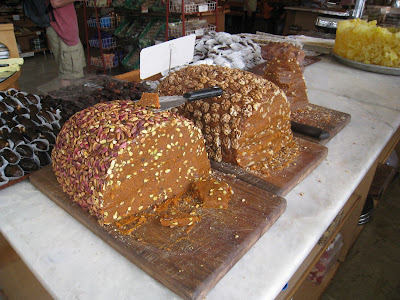
We stayed the night in Lattakia which was an OK place but nothing of particular note to see although we highly recommend checking out some of the fantastic chocolate shops around. The one we went to had some great stuff on offer. Dates ½ dipped in chocolate and stuffed with almonds or walnuts; whole apricots ½ dipped in chocolate and stuffed with nuts; balls of orange pulp dipped in chocolate with almonds on top and many many others.

You can see these in the photo above on the middle right. They’re moulds of carrot pulp studded with whole pistachios and ½ walnuts. It looked a bit like coarse quince or apricot paste and I got a surprise when I tasted it. They looked pretty and very edible but not for me thanks.
Early the next morning we caught a bus from Lattakia to Antakya in Turkey and had an eight hour wait there before hopping on an overnight bus to Antalya on the coast. We spent the time looking round and had a few locals just bowl on up wanting to practice their English. Some were very forward and caught us by surprise, moving in quickly and closely, saying hello, asking us our names, how we were, where we were from. We visited the Antakya Archaeological Museum which is famous for its collection of mosaics. If you like that sort of thing, it is well worth a look as they had rooms and rooms full of these huge mosaics.


This is my favourite mosaic of all I’ve seen even though it was largely ruined and somewhat stupidly, I didn’t take a photo of the whole thing so its difficult now to show the size of it and enable you imagine how it must have looked when it was complete. The first one I’ve seen with fish – there was a dolphin, eel, lobster, grouper, squid and many others. It was huge - about 4m high and 3m wide and was called “Mosaic of the calendar with Oceanus and Thetis” and dated from 2nd century AD. I stood for a long long time looking at this.


This isn’t a very good photo but shows the fat-tailed sheep I mentioned in another posting. Others have been difficult to photograph as they’re usually far away grazing but these ones were standing outside where we were catching a bus, sheltering behind a rubbish bin (it was about to pelt it down with rain) and you can see the massive amount of fat that they carry around their tails. It all wobbles about from side to side when they walk – looks very strange and quite disgusting on the carcass once slaughtered

The bus journey from Antakya to Antalya took 15 hours and was the longest bus trip we’ve done yet and I’m not that keen on doing anything longer unless absolutely necessary. It took us 17 ½ hours in total to get to Olympos, a very chilled out spot on the coast about two hours from Antalya. The bus trip was eventful in itself and I was woken at around 0300 by this massive bang and huge shudder. It turned out that we’d been hit by another bus on roads not designed for these huge buses and it made sense why the trip took that long. Narrow roads, no shoulder, hairpin bends and sleepy drivers are not good combinations.
We’re looking forward to chilling out for a few days in Olympos with its lovely beach and sprawling wild ruins.
I forgot to mention the bats in Tripoli. How could I forget?! Adjacent to where we were staying was a couple of buildings that had been bombed a long long time ago and in the twilight, out came the bats from the ruins. They looked incredible and masses of them swooped and ducked around in the air until it got darker then most headed off to wherever bats go overnight. Some however, stayed closer to home and throughout the night squeaked and chattered away – a very comforting sound to wake to in the night strangely enough.
Before heading up to Bcharre for the night we headed down the coast to Byblos which is an old old port, first settled in 5000 BC and has the reputation of being the oldest city in the world (but we’ve figured that there are a few of those around the Middle East!). To be completely honest (and apologies to any Lebanese reading this), we were slightly under-whelmed by Byblos. While its incredibly old and the ruins are in a stunning position right on a point by the sea, they are very spread out and are just so ruined (fire and earthquake helped bring them down) its really difficult to picture what was what. It really depends on what cranks your handle as some people loved it but we’re glad we didn’t take days out to stay there. Perhaps if we’d organised a guide to talk us through it we might have a different view.
This is how ruined Byblos is (obviously the intact building is new!)

Beach down the coast from Byblos. There was loads of kite surfers out having a ball in the wind.

After Byblos we headed up to Bcharre on a minibus that had zero suspension (some of the bumps really hurt!). Our packs were shoved in the back space with the spare wheel and greasy crank handle (some of the minibuses need to be jump or crank started) and when the bus filled up and over filled, we knew exactly why they were so determined to squeeze our gear in the back. That bus driver was on a mission to pack as many people into that bus as possible and he even had someone jammed between his left-hand side and the drivers door. At the back we had good ventilation from the shot-out back window that had some glass only just hanging in there.
Bcharre. The cliffs into the valley drop away vertically from the other side of the town

We’d broadly arranged with the guys we’d met the day before to rock up later in the day but didn’t know where we were going other than to a place by one of the churches. Bcharre is a small place and there aren’t many travellers in Lebanon at the moment let alone Bcharre, so it wasn’t any surprise that we bumped into one of them by chance. These guys were so good to us. They took us to their place, gave us a key then left us to our own devices for the night which suited us fine. We were absolutely stoked to have somewhere to hang out and did just normal everyday things like watch telly, cook some dinner, clean ourselves up etc. We didn’t realise that the power was rationed and I was in the shower when the lights went out just after midnight. Left in the pitch dark I was fine for a bit but when there was silence in the house after calling Euans name, I got a bit worried. I got a bit panicky when he still didn’t answer the second and third time but it turned out he was still stumbling round a strange lounge in the pitch black looking for the way to the room we were sleeping in to try and find a torch.
The place we stayed in was one floor in a five-story building with a massive flat deck. The house had seen some action in the past as there was a bullet hole in a high window then a bullet hole in a big mirror. Their grandfather/father had been asleep and there had been sniper fire from just up the valley and the bullet went through the window, into the mirror on the wall dividing the bedroom and the lounge. Not sure what the outcome was but it didn’t sound like the event was anything too unusual around that time. The guys weren’t home until well after midnight and one of them had to take his fiancée back over to the Bekaar Valley, an hours drive away up and over the pass where we were at yesterday. Once you’re over the pass you’re definitely in Hezbollah territory so he had a hand gun with him as its not safe to drive at night in the mountains. I don’t know why, but handguns make me much more nervous than big guns. I think it’s that they’re more mobile and seem to be waved round in the air more than bigger guns.
We went hiking in the valley the next day and that was great fun. The really rough path led along the side of the valley and passed quite a few ancient churches dug into the mountainside. One had a monk that had been living there for the last 20 years in isolation. I thought they were taking the mickey at first but they weren’t, he really was there and he’s not even from Lebanon; he’s from Columbia. I somehow managed to walk forcefully into an rock overhang and cracked my head something chronic. At least Euan, who was behind me, knew to look out for it and didn’t do the same thing. The path we were walking on was very narrow with a very very steep drop off so I was head down looking where I was going and my cap blocked my peripheral vision. I’m happy to say I wasn’t pole-axed but I did give it some and the bump on my head as a result was rather large. My cap was very nearly biffed into the valley in disgust.
We were carting quite a bit of food with the intention of having a BBQ and Euan managed to get the pack with the meat in it, surrounded by ice to keep it cool. The plastic bag leaked and Euan had water running all down his legs and as one of the guys said, looked like he’d “done it in his pants”. Very silly and childish but it was all rather funny at the time (except for E of course!).
View up the Qadisha Valley

We were trying to get to river at the bottom of the valley but couldn’t find the path down we went off road instead. Brilliant fun. Down a steep steep bank with all these (thorn as I discovered) trees and all sorts of fantastic stuff to hang on to that came away in your hand just as you got a good grip and then down you went! I was in my element but managed to rip more holes in my shirt (another one ruined) and slid most of the way and got down well in time to watch the others coming down. One of the guys still had the damn handgun that was being waved around in the air as he helped his fiancée down. At the bottom, Euan grinned, shook his head and said he thought he was going out for a nice quiet hike and BBQ and didn’t expect the manic scrambling and rather dangerous decent. I asked him what else did he expect going hiking with two Aussies and a Kiwi?!! Then we managed to lose one of the guys and before we knew it, out came the handgun and BOOM into the air. Quite what that was going to achieve I have no idea but it was enough to give me a damn good fright anyhow.
We eventually found a nice spot by the river, made a good fire and proceeded to throw on whole onions, whole garlic bulbs, potatoes and patties of heavily spiced beef mince (after I objected to eating the raw stuff smeared onto flat-bread). All this went on the embers and tasted so good once the ash had been blown off it and was washed down with whisky or arak – a locally brewed Lebanese aniseed liquor that blows doors off (but somehow made me want to sleep!).
That milky-looking drink is arak

Raw mince in flat bread with a whisky to wash it down. Nice!

Round the barbie

All in all, a fantastic day and by the time we stumbled home (the car kept bottoming out on the gravel road so three of us had to walk some of the way) we were absolutely shattered but man, did we have a great day.
We happily stayed another night there and once the power came back on just after midnight, did some washing which I was quite excited about stupidly enough. I’m thoroughly sick of doing hand washing and the clothes did need a really good wash.
Breakfast while we were there was these flatbreads baked fresh while you waited. The baker took the dough, flattened it and sprinkled whatever you wanted on it (I had crumbly white cheese but you could have mince or stuff that was like oregano pesto) then stuck it in a wood oven for a few minutes to cook. When my one came out of the oven it was all crispy round the edges with the cheese soft in the middle and the baker folded it in half, wrapped it in a bit of paper and handed it over. YUM!! The baker was very religious and when Euan went down there with one of the guys, the baker made the sign of the cross then asked if Euan was Christian. When Euan let on that he was Roman Catholic, the baker came rushing round the counter, saying something in Arabic then grabbed Euans face between his two hands and planted a big smacking kiss on his forehead. Those of you that know Euan will know he’s not particularly tactile even with those he knows well so to have a strange man rush him must have been quite terrifying. The look on his face would have been priceless!
It was with reluctance that we left and while we were tempted to take up the offer of staying a few more days, we had to move onwards so swapped addresses and will catch up with both the guys when we arrive in Sydney in late November.
NB. I've had some emails asking for maps showing where we are and while I've added a route map to the main page, I'm trying to insert a link in each entry that shows where we are in the world. It would appear that some countries, like Israel and Lebanon are not 'recognised' on some of the world map sites - for eg, in one, the map of Israel is blank but is called "No Mans Land" and in Google Maps, Lebanon is blank. I'll keep trying to find a way of showing you where we are though!
The Syrian/Lebanese border was only 30mins drive from Damascus and probably the easiest border crossing of the six we’ve done thus far. We were slightly gutted to find that if you fly into Lebanon then visas are free but if you cross via land, you have to pay (contrary to our understanding and we did try arguing but its not really worth arguing with border officials!). As soon as the bus was over the border (which is in a valley), it headed up a steep mountain range, then down down down the other side with valleys and mountains either side (all green) and there was the realisation that Lebanon wasn’t a country that could be exited easily and fast if need be! We were amazed at the difference between Syria and Lebanon. The scenery down the mountains into Beirut is rather beautiful compared to Syria and the difference between the two countries extended beyond the landscape. There were flashy billboards, the houses were not so jerry-built and, from first observations, the driving was some of the most manic we’ve seen – worse than Bangkok or Saigon (which are flat) and this was on steep roads with many many hairpin bends. For every few nice houses, there was one that had been completely bombed out with bullet holes riddling the external walls and the City was pretty much the same.
Old (undamaged) house in Beirut

Slightly bombed building (check out the sandbags on the 1st floor ledge)

Downtown Beirut is mostly new and you could be in any western city (minus the tanks) but walk a few blocks and you’d come across huge bombed out buildings or others with bits smashed off riddled with bullet holes. There is a massive project underway to rebuild Downtown Beirut and they’ve redeveloped a huge area of land and have reclaimed a lot from the sea. It was didn’t bear thinking about what would happen to all the new buildings, marina and the flash Downtown shopping area if there was more international conflict.
All this is new development

The new and the old

As above

Tanks are still patrolling the streets and there are army stationed at every main intersection backed up by tanks, jeeps and personnel carriers plus this contraption that popped the cars of tyres. Shortly after we arrived at the pension an army convoy rattled past and we were woken by another convoy at 0430 the next morning. We got into the habit of checking out the news every days just in case.
Manned tank at checkpoint before Beirut

War-torn street

By contrast, Downtown Beirut
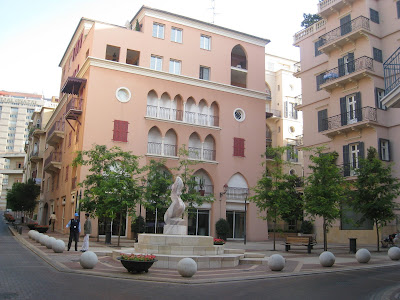
Building just up the hill from the Downtown

We’d heard Beirut is a real party city and it hasn’t disappointed thus far with bars all over the show, a huge open air concert staged the night we arrived (which might have explained the army presence?) and every night we stayed there was music until the wee hours.
The Roman ruins of Baalbek in the Bekaar Valley are 85km out of the city and we headed there for the day but before we left we treated ourselves to a coffee at one of the upmarket cafes where Euan spotted a mouse in the bread basket. One of the other girls saw it too and then the entire staff was out watching as this one chap tried to catch this mouse in a plastic bag in one hand to catch the mouse. We thought “Yeah right!” but he actually caught it!! He was so amazed that he went to show his colleagues and the damn thing jumped right out. The staff scattered, the mouse went awol and there were chaps bending double behind the coffee machines laughing too much to stand. All this in amongst a lot of well-to-do Lebanese folk chatting in French over their morning coffee. A brilliant start to the day.
The temple in Baalbek is just phenomenal and while the site isn’t that big, the ruins dwarf any others we’ve seen thus far in scale, size of the blocks and sheer engineering. Its claimed to be the most impressive Roman site outside Italy in the world and its difficult to believe that it isn’t the most impressive. Even the columns were huge (there are only six columns that remain standing – see picture below)

Big rock near the Bacchus Temple

Me sitting by the (huge) column bases (2nd from left)

Check out how bıg these bases are!

The massive Temple of Bacchus

This is inside the temple of Bacchus – Euan is giving it some scale ın the bottom middle of the picture (if you can see him!)

The outer wall blocks are 30-33ft in length, 14ft high, 10ft deep and weight approx 450 tonnes each and at the entrance, there were huge granite columns (below) that had come from Aswan in Egypt.

There are three even larger stones, called the Trilithon and these weigh over 1200 tonnes each (I’m sitting on the fourth below). Apparently, this is the largest hewn stone in the world and its still joined to the quarry at its base. The temple was never finished so this mammoth stone never joined the other three at the Baalbek temple, some 500m down the road. Noone has ever actually worked out how they managed to transport the other three, let alone lift them into place.

Finding this stone wasn’t easy – sounds crazy I know. We hunted all through the site for it, then headed round the back of the temple on a small track but got shouted at by some locals from across a field. We went over to them and one chap showed Euan where to go and the others told me in broken English that it wasn’t safe to walk down where we were heading as there were “bad people”. Fair enough! We didn’t need any persuading. The Bekaar Valley is Hezbollah (Party of God) land fair and square and we didn’t realise it at the time but apparently it’s a ‘safe zone’ and the military don’t go there (we didn’t spot any army at all in the Valley). There was one decidedly dodgy character eyeing us up when we were looking at the big stone in the quarry and when we turned to go, he followed us quite quickly and I said to Euan (who wasn’t really listening) that we should get out of there quick smart and off I went. I turned around and Euan was wandering along with this chap slowly closing in and only then did he move. Needless to say I had a bit to say once we’d reached the main road. In the minibus back through the Valley a few of the locals entertained themselves trying to speak to us in English and another was happily showing us pictures on his mobile of him shooting with his M16. Shooting what we’re not sure but apparently everyone in the area owns at least one semi-auto weapon. They were characters but I wouldn’t want to cross them that’s for sure so.
On our way back from Baalbek in the minibus, we were caught in the middle of the loudest, biggest argument I’ve ever seen or heard. Arabic is just the most expressive language and the people carry out arguments with flair with body language, expressions and hand gestures to match. Its brilliant to watch (but not when you’re caught in the cross-fire!!). A lady was at the back of the minibus (a normal van), screaming at the driver in the front (she’d tried to pay him ½ the fare she should have) and there were hands waving, voices raised to the point that other passengers had their hands on their ears and were saying “hallas, hallas” (meaning “enough, enough”) and the driver definitely wasn’t looking at the hairpin bends in front of him. He ended up holding back the money she had passed him (via the rest of us passengers) but none of us were touching the damn stuff after all the shouting, no way! He ended up screwing it in a ball and biffing it back at her while on the move down the mountain. The shouting that followed reached a crescendo and there was nothing we could (or particularly wanted to) do. Even Euan (who won’t normally say boo to a goose) said to me “what if I turned round to her and said ‘Oi, you, stop taking the piss’ and to the driver ’hey, just bloody keep your eyes on the road’”. I reckoned it was best if we kept out of it.
On our second day we visited the Jeita Grotto. We weren’t allowed to take photos and the grotto is difficult to describe but it is very very impressive. It stretches for about 750m into the mountain and is just a huge cavern filled with the most enormous stalactites and stalagmites that we’d ever seen. Many of them had fused and, over millions of years, had formed entire walls that looked like massive cathedral organs. It was simply stunning. There is an upper grotto that you can walk in and, 119m below is the lower grotto, which you have to travel through by boat. In some parts of the upper canyon you can see down to the lower canyon – it looked like another mystical world way way down below.
Later that day we just walked through Beirut. We walked for over 4 hours and saw some really interesting stuff and passed through very different neighbourhoods. Strangely enough, we came across a chap who’d travelled across the border with us in the same bus. He was quite astounded to see us and was almost speechless. He didn’t speak English but we had a bit of a natter (its amazing how much you can convey without understand a word each other is saying) and about five minutes after we met him, we heard someone running up behind us and he’d followed us to bring us bottles of orange juice. His grin was nearly as big as our eyes. We couldn’t believe that someone would do that!
We came across the main shopping street that had clearly seen some action. These women were just checking out the shoes in the window but we were more interested in the bullet holes in the glass than the shoes.
Women checking out the latest shoe fashions
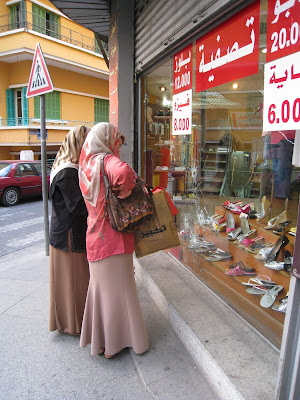
...not minding the multiple bullet holes in the window from the shooting a few weeks earlier

Something that made this place stand out from others in Syria, Turkey, Israel or Jordan was the extremely genuine welcoming manner and politeness from the people on a daily basis. There were a few isolated incidents that stood out but on the whole, it continued throughout every day we were there. It didn’t seem to matter who – we were treated the same throughout Beirut. Even the policemen were polite. We were resting on a wall and while we’d just walked through a police checkpoint and there were the usual barricades up, this police officer walks over and very politely says “excuse me and sorry to trouble you but you are sitting in a military zone. Could you kindly move on please”. We just looked at him. I mean, the whole city is a military zone and the wall looked no different to anything else. We moved on anyhow, he was so nice about it and was carrying an M16 (a friend in NZ used to collect automatic weapons as a hobby).
We went back to the Bekaar Valley the next day to visit one of Lebanons famous vineyards, Chateau Ksara. A friend who is a great wine-buff had recommended Chateau Musar and that was the preference but it was just too tricky to get to and they only took visitors by appointment. It was going to be difficult for us to turn up at a particular time as we were very much at the mercy of the minibuses and the very random drivers who had a habit of passing passengers from bus to bus at random. Chateau Ksara was a Monastery and the monks planted some vineyards and by chance, some years later, discovered that the Monastery was positioned over a series of caves (about 2km) that proved to be excellent wine cellars and this is now where all the wine is stored (how lucky is that?). The vineyard is now privately owned by four Lebanese businessmen and we highly recommend a visit if you’re ever in Lebanon. Even though there were only two of us, we were welcomed, shown every hospitality, given an extremely generous wine tasting session and even got to tour the factory (not normally done for visitors but I was curious). We also got to sample the Arak (aniseed liquor) straight from the vat which just about blew our doors off as it hasn’t yet had the water added! We joined another couple for the wine tasting. He was Irish and in Lebanon for the last six years with the Irish Army working with the UN on the Lebanese/Syrian border. An interesting chap to talk to with some interesting stories but was a bit incredulous when he found out we were travelling everywhere on local transport. When he found out where we’d been (Israel, Syria etc) he said “hell, there aren’t many that would do the journey you guys have done at this time” and we both wondered “what do you know that we don’t??! The visit to Chateau Ksara was a highlight and we decided to add a few kilos to our packs in the form of fine red wine was a small sacrifice

After a rather uneventful journey (by comparison) back to Beirut we visited the Museum and we were the only two people there. Museums are quite spooky when they’re virtually empty. I was still upset as I’d left the bottoms to my zip-off pants on the mini-bus and there were tears (strange what you value isn’t it?). I had to walk back through the City with shorts on and in a grump, lagged behind but doing so allowed me to take the sneaky pic below. The soldier manning the tank was hidden in a tree so didn’t see me take the picture.

After being in Beirut for four days, we’ve come to the definite conclusion that the driving is worse, far worse than anywhere else we’ve travelled. Bangkok, Ho Chi Minh or Delhi to name a few. There are no road rules and it’s the combination of that along with high speed that makes it so dangerous. Overtaking, undertaking, sideways round corners, going the wrong way down the road, u-turns on main highways, you name it, the Lebanese do it. Crossing a road is dicing with death – I’m not kidding. After leaping out of the way of a car, I made the comment to Euan that anyone remotely nervy wouldn’t last here for more than 10 mins. The combination of tanks rumbling the streets, sirens sounding, people shouting and the traffic would finish nerves off. There are cops directing the traffic but even when they reprimand a driver for driving the wrong way down a dual carriage way they seem to do it half-heartedly then stand their shaking their head as the driver carries on. We guess they’ve bigger problems to deal with.
We’re leaving Beirut, very reluctantly, to travel to Tripoli. We could have stayed here for weeks.
Lebanon is so small (you can drive the length of the country in ½ a day) that it makes sense to base yourself somewhere central like Beirut then travel out from there. This is basically what we did for the last four days but left with some reluctance to travel to Tripoli for a few nights before heading back into Syria. We flagged down a minibus on the main drag out of Beirut and the 85km trip to Tripoli turned out to be the cheapest journey yet - the equivalent of £1.50 pp for the entire trip. A bargain and the entertainment of listening to the banter in Arabic and watching the body language en route is worth ten times that. Tripoli is more like some of the Syrian cities in that it has retained more of the Middle Eastern culture that Beirut seems to have lost and is also visibly less war-torn. There are still souqs galore to look around and some very old family-run businesses that are still thriving well. We visited one of them, a soap maker, whose family had been making soap since 1803 (and some of the equipment is just as old!). Once again, we were the only two visiting and we were welcomed warmly and given a tour of the factory (albeit tiny!) and shown exactly how the soap was made. Its beautiful soap and no whales at risk here as the soap is made from olive and coconut oil.
The main workshop of the Sharkass soap factory

Mr Sharkass at work. The towers are soaps that he has shaped, polished and finished by hand

The entrance to the soap factory

These soaps were slightly larger than snooker balls but much prettier!

We did not see anyone else who wasn’t obviously from Lebanon for well over a day and everywhere we went we people saying to us with this lovely accent “wellcaam to Lebanon …. welllcaam” – a fantastic phrase that comes across as very heart-felt. We were given cherries to sample, handfuls of peas in the pod and other bits and pieces as we walked the streets and the souqs and generally made to feel very welcome.
This tiny lady made the best falafel sandwiches. They were so good we went back for more and when I asked if I could take her photo, she spent a few seconds preening, tucking her hair out of the way, making sure her scarf was straight etc (but no smile at the end of it).

Every single one of these taxis was a Mercedes. Many were more beaten up than those in Syria – no doubt a reflection on the manic driving here. These were parked around one side of the Town Square in the old part of Tripoli.

On our second day in Tripoli here we visited Bcharre, high up in the Qadisha Valley (the Holy Valley), again by minibus with a load of local soldiers. The valleys in the mountains above the coast are amazing and Bcharre is a small town perched high on a cliff top at an altitude of just under 2000m, surrounded by these beautiful rolling mountains. We’d gone there mainly to see the last remaining forest (patch really) of Cedars, some of which are 3000 years old. We objected to the taxi fare of 20,000 Lebanese pounds (equivalent to about US$12) and decided to walk/hitch up the mountain. We’d gone about 10mins and a car pulled up beside us and this chap said “hey guys, where are you going?”. We told him and he said “Get in!”. Then he said “You’re not from Australia are you?” and I SO thought they were both Lebanese putting on Aussie accents but when I told them I was from NZ, one of them said “No way!! A bloody Kiwi!!” and then I knew they really were from Australia. It turned out that their father and grandfather was Lebanese and had left them property here, so they were visiting from Sydney. They couldn’t quite believe that we were really walking all the way up the mountain (6km so not that far) to the cedars and happily gave us a mini tour of the immediate area and invited us to stay with them for a few days. They took us to a natural spring that continuously bubbled up out of the depths, took us to a lookout with a great view of the Qadisha Valley then drove us up to the pass to the Bekaar Valley over the other side of the mountain.
Bcharre is the mass of houses on the right hand side

The pass is at over 3000m and the day was so clear that we could see the Bekaar Valley stretching out on one side and the Qadisha Valley heading steeply downwards on the other but man, was it cold! There was snow still on the ground and the gusty wind nearly blew us over.
The valley behind us is the Bekaar Valley and Baalbec (where the temple ruins are) is the dark patch right by Euans right ear. The white patch at the bottom of the picture is snow (and no, we weren’t dressed for the conditions but, to be fair, we’d not expected to meet folk who would drop us off at the summit!).

They were going to leave us there to walk/hitch back down but, as it’s a very remote area and bordering the Hezbollah territory, thought better of it as its not that safe and waited until someone else came along to give us a ride back down to the Cedars which we’d passed on our way up. The ‘someone else’ were a couple of chaps in a transport truck and Euan and I happily scrambled up into the cab and got a lift back down the mountain to the Cedars.

I had the best seat in the truck and had a straight down view of the hairpin bends and of the driver who was not really paying attention to where he was going! Euan and the other chap in the truck had moved into the back of the cab and were trying to understand each other enough to hold a conversation.
Oi!! Eyes on the road please!!

We were just so glad that we didn’t have to walk though as there were very few cars around, it was freezing plus we couldn’t cut the corners of the hairpin bends due to unexploded mines and tank shells so it would have been a long old walk back down the mountain.
This is the view down the valley. I took this about ½ way down and the patch of green is the Cedars (this is all that’s left of them) where we needed to get to. The road winds back and forth all the way down so it would have taken us hours.

There used to be huge Cedar forests covering the mountains but they were used 1000s of years ago and have been reduced to the patch you can see in the photo above. Allegedly many were sent to King Solomon to build a temple in Jerusalem and obviously no-one had the foresight to replant. It is an incredibly holy place (mentioned in the Bible), is very peaceful and some of the trees are huge but these are few and far between.

The wall is to stop the goats getting in. The dip in the horizon above the Cedars is where we were dropped off at the pass.

We walked from the Cedars back to Bcharre (about 9km but downhill) and got some amazing views down the valley. We took the old road, built by the French but it did mean zero traffic so no chance of a lift. You can see the deep rift of the valley in the centre of the picture. The scenery is very dramatic and stunning in early morning/evening.
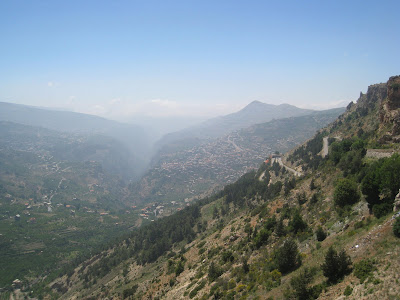
Bcharre. You can see the massive church dominating the cliff line. In Jerusalem, there was the ongoing seemingly never-ending call to prayer. Here in Bcharre, its the church bells from the many many churches echoing up and down the valley

We headed back to Tripoli late afternoon as we’d already committed to another night there and had left all our gear there. We decided that the kind offer of accommodation, trekking and sight-seeing in Bcharre was too good to pass up and we're not really following any set plan so decided to head back here the next day.


