skip to main |
skip to sidebar
We had such a fleeting visit to Auckland and I’m amazed we were able to catch up with the family that we did but this was helped by Dad holding his 80th birthday party the day before we flew out. We stayed with my auntie and uncle, Margie and Richard, and managed to see a bit of them in between zooming around! We decided to spend our ‘spare’ afternoon on the day we arrived out at Piha, a favourite surf beach where we spent loads of time when we lived in Auckland in the late 80’s. I was stoked to see that Piha hasn’t changed that much.

Piha is about 45 minutes from Auckland City and the last 20 minutes is through the Waitakare Ranges that seem just as wild as they were 20 years ago. The surf on the beach didn’t disappoint and we were confronted with waves that were way taller than us and we got dumped a fair few times. We took a leaf out of Marks book and ran wildly at the waves, throwing ourselves at them only to get tumbled round like we were in a washing machine. It’s a pretty dangerous beach so heavily guarded and two surfers were rescued while we were there.

The beach wasn’t busy and there were some fantastically positioned houses right on the beachfront. The black sand was so hot we couldn’t walk on it in bare feet.

On the way back into Auckland we stopped off for a BBQ at my stepsisters place, perched high on a hill in the Waitakare Ranges. Katie and Tim have a fantastic view over the city but unfortunately it was a bit hazy when we were there (but I’m sure you get the general idea!). The mountain in the distance on the left is Rangitoto Island, a volcanic island in the Hauraki Gulf, just outside the Auckland Harbour.

Dads 80th birthday party was great fun as there were loads of people there who I’d not seen for years and years, plus family from both Mum and Dads side of the family who I haven’t seen for at least four years. This is Dad, my nephew Nick, my older brother Paul and Grace.

These are my cousins, Charlotte (middle) and Philip (back right) and we’re missing their older brother, Nigel, who is in the UK. The kids are all Charlotte and her husband Jeffs (in green). I’m glad we’re sitting down as my cousins on Mums side are super tall and lean and I’ve always been the shortest in family photos. The kids don’t count but Charlottes 12 year old daughter Eden is nearly as tall as me anyway!!

This is almost the entire family (minus a few cousins who are overseas!). Dad did a brilliant job of getting everyone together for a meal that evening so it was a pretty full on day but a great opportunity for Euan to meet the family.

Rather than have a photo side by side, Charlotte suggested we have a go on this super-sized rocking horse but she wouldn’t take her feet off the ground because she thought we were going to go over backwards! We used to spend loads of time both riding double on my pony when we were kids and there were plenty of times when we both hit the ground. Somehow I don’t think she’s forgotten it.

I was hesitant to put this photo in but it’s the only photo we have of Auckland. It was pretty awful weather while we were there so no photos of the harbour bridge and this is the only one we have of the City. The shadow of ranges in the background is the Waitakere Ranges. We were up Mt Victoria in Devonport when this storm came over and ruined the views.

This is Rangitoto Island (at a guess, the toadstools are vents from an underground Naval bunker)

We left NZ for Chile the day after Dads party and I’d asked no one to come to the airport to see us off which was just as well as I was incredibly upset to leave without anyone there to say goodbye.
The drive from Ohiwa to Auckland should take about four hours but we’d decided to overnight somewhere on the way and visit Rotorua en route. We left Ohiwa with reluctance (there seems to be a common theme here!) and drove the two hours to the Waiotapu geothermal park, just outside of Rotorua.
View Larger Map
Waiotapu is a lot more touristy than Craters of the Moon but probably a better experience and this is reflected in the entrance fee. The various pools had great names like ‘The Devils Inkpots’

and ‘Champagne Pool’
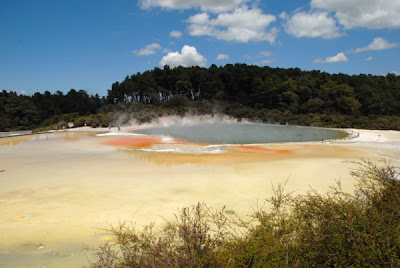
because it has loads of little bubble trickling their way up from the depths
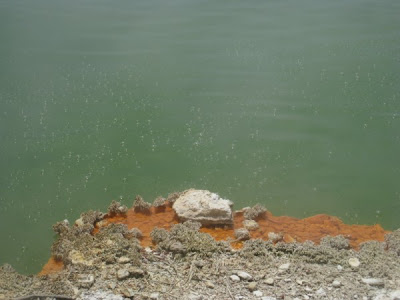
The Champagne Pool has a crusty border that somehow holds all the bubbly water in and around the edge is this fantastic rusty orange colour that reminded me of scallop roe.
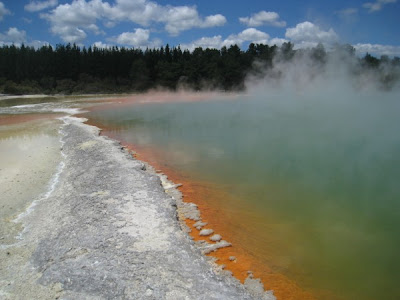
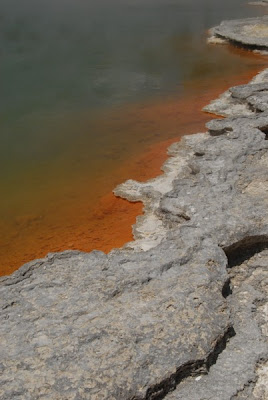
It was difficult to get a decent photo though

as we kept getting steamed out and one or both of us would emerge coughing, eyes squeezed closed. That’s Euan with his back to the steam off to the right.
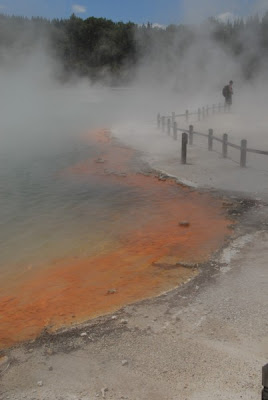
The colour of the sulphur was fantastic
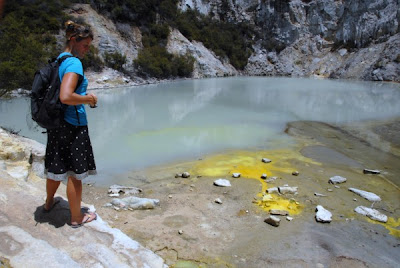
and this was a mini Pamukkale with loads of little ridges that the water trickled over for a good 100m plus.
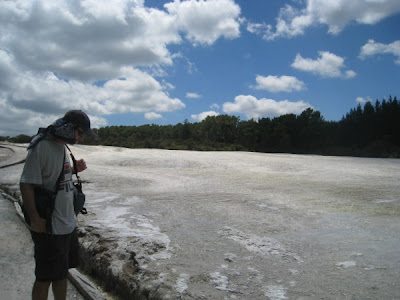
Now, this pool was incredible. It looked like someone had dumped bottles and bottles of the most lurid-coloured lime cordial in it but do you think we could get the colour to come out in the photos? No way. Gutted.

Euan left a bit disappointed as he’d wanted to see boiling mud but no mud was being boiled that day. We headed off then came across a sign that said ‘Mud Pools’ so we hooned off for a look and there it was!! This looks pretty tame but
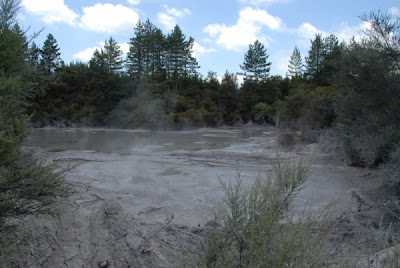
it was quite lively, with mud erupting out of nowhere every few seconds

Some were violent explosions, mostly from under water
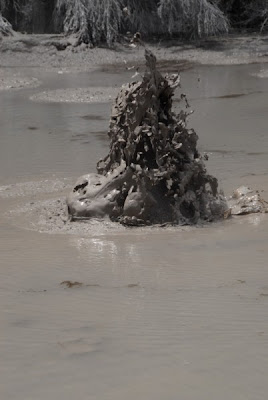
but in where the mud was thicker and there was no water, the mud just gently plopped like porridge does when cooking it on a stove.
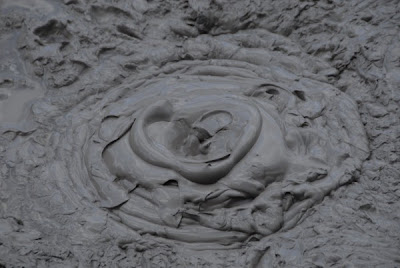
It was almost cute!
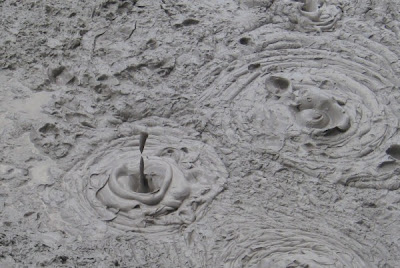
and we just couldn’t stop taking photos! Each one was different and there was always a different explosion to capture
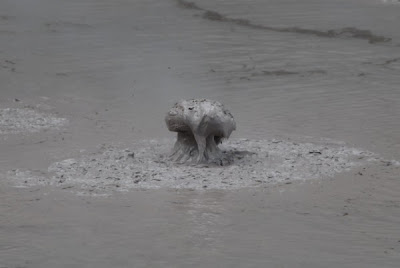
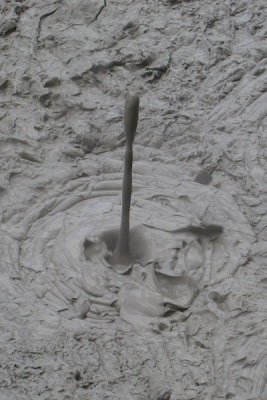
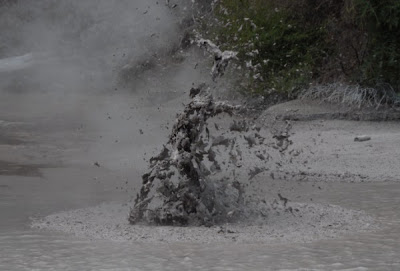
It was a bit random but so fun to watch. We dragged ourselves away and did something that no self-respecting kiwi girl who had had anything to do with farming would do… we went to the Agrodome to watch the ‘Sheep Show’. Yes, we did. I crept in, head down hoping like hell that none of my university class mates had wound up on stage as a 'show' shearer. Anyhow, I soon forgot that when I saw the 19 champion rams of all different breeds. Euan even got up close and personal with the Merino who, even though he is on a platform, was massive, wrinkly and very placid.
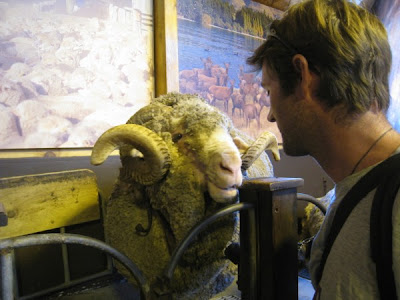
It was actually really good, albeit aimed squarely at tourists. Each ram was introduced, we were told a bit about the breed, what they’re used for etc and the rams would trot to their place and get chained there. There was a bit of a hoohah with them eating each other’s food and having fisty cuffs but that only added to the amusement. One of them didn’t want to wait for his turn and just jumped out and ran to his place while another was still being talked about.
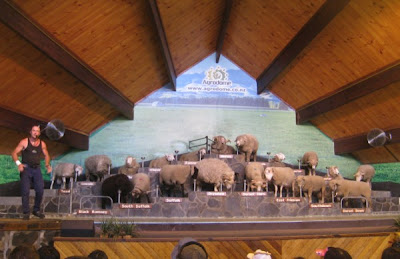
What was funny was that when they’d finished eating, they lay down and went to sleep! The Romney in the top left was the worst. He was dead to the world and took some waking up.
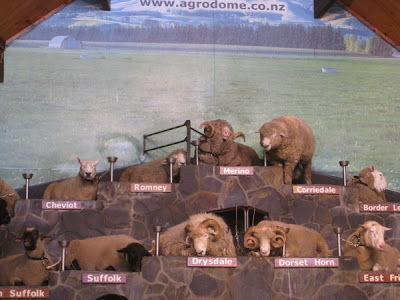
Euan finally got to see a sheep being shorn. I had been looking out for shearing gangs at the shearing sheds we’d passed but we didn't see any sheep in the yards to be shorn. When I mentioned to Brig that we were going to the Agrodome she’d said we should have told her earlier as she had 30 sheep that she needed to shear and Euan could have helped. A missed opportunity for sure.
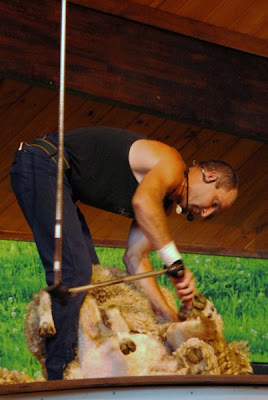
There was a funny moment when five kids from other countries got up on stage and were given bottles of milk (with teats) and the shearer said (jokingly) “one, two, three drink” and all five put the teats in the mouth and drank! I don’t think the chap thought they’d do it. Anyhow, the next moment, five hungry lambs bombarded the kids, bunting and squabbling over the bottles. The look on these kids faces, who’d probably never ever got to even touch a sheep, was absolutely priceless.
It was quite interesting for to see who goes to these sorts of things. There were people from Uganda, Tanzinia, Sweden, Switzerland, Germany, India, China, Japan, Trinidad and the list went on. There were only about 3 Kiwis in the audience I noted…..
Next stop was Rotorua – a geothermal area and you can smell the sulphur in the air. The open park areas around the town can be dangerous and many parts are fenced off
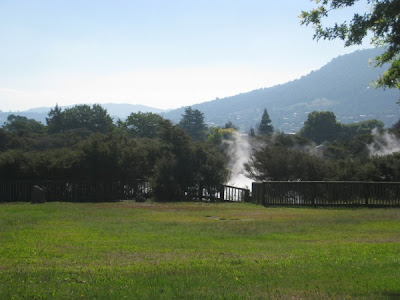
to avoid people wandering into things like this but occasionally it does happen and someone wanders off and dies from falling in.
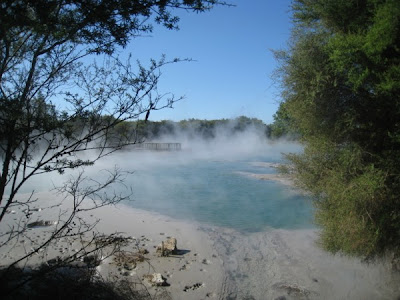
We made our way northwards that night and stayed in an area I’ve always driven through but never stopped at in the Karangahake Gorge. Karangahake is an old mining town from the 1800’s. It’s a nice place with some fantastic walks through the remnants of the old mining village and it was once home to 3000 people. Now there are only a handful of houses left there and most traffic seems to pass on through.
While neither Euan or I are twitchers, but this bird has kept us entertained throughout our time here. It’s called a Tui and it's native to NZ. I never paid much attention to it previously, it was just part of the furniture (so to speak), but I've been absolutely enchanted by it this time round.
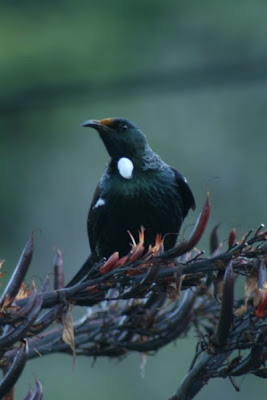
The noises Tuis make are hugely variable, different to each individual and the fact they have two voice boxes enables them to create a huge range of sound, some beyond the human register. Among the more musical notes are clicks, cackles, timber-like creaks, knocks and wheezing sounds. At the risk of being a bird geek, I found this clip on YouTube that is far better than my description!
http://www.youtube.com/watch?v=jNgwehRPiPo&NR=1
We spent the evening sitting on a rock in the river having a few beers and watching the trout (and listening to the Tuis!).

It was a pleasant place to stay and a good stopover point on our way to Auckland, about two hours drive away.
We did a day trip to White Island, NZs most active volcano, on a perfect day, weather wise. The island lies about 50km off the coast and it takes about 2 ½ hours to get there but longer if there is marine wildlife about (as there often is).
View Larger Map
The boat ride was really pleasant and it was a perfect day to be on the water. We saw pods of dolphins both on the way out and back, and a bait ball of herring being chased by Kawhai (fish) so the journey took longer than usual as we stopped to watch.
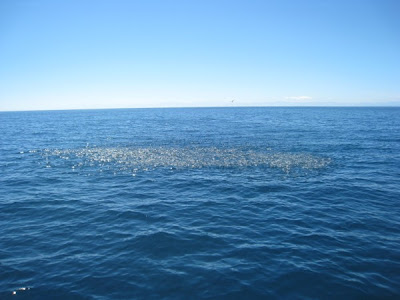
White Island is privately owned by an Auckland family but was originally sold by the Maori to the Europeans in the 1830s for two hogshead of rum. It’s seems to be a bit of a cash cow now, with money from every person taken there going to the family but the good thing about it being privately owned is that the public has greater access and is allowed to be guided relatively freely around the crater.
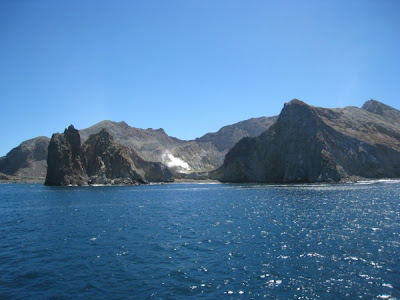
It also gets quite rough out there with around 12m swells and, as a result, the boats can only land people on about 150 days per year. From the mainland, White Island doesn’t look much and it wasn't steaming or smoking like I remember it used to but once you got there and landed, it was pretty obvious that there was a whole heap of activity going on under the ground and the last major eruption was in 2000.
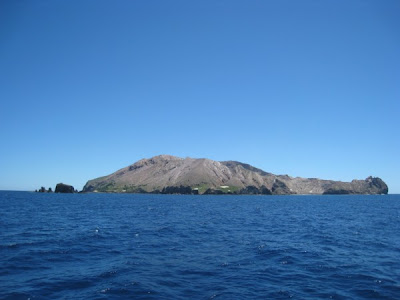
Only 321m of White Island is above sea level, with the remaining 760m sitting below the sea, covering an area of 16x18km. Its not until you get close that you see an eruption (in 1914) had clean blown the side out of the crater.
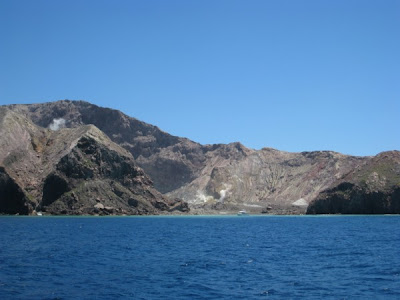
A condition of issuing a landing permit to visitors is that all visitors must be issued with a hard hat (fat lot of good that will do for you in an eruption!) and a gas mask. The latter was actually quite useful as the fumes were pretty acrid at times. They might look funny but at least the colour of the helmet and mask match!
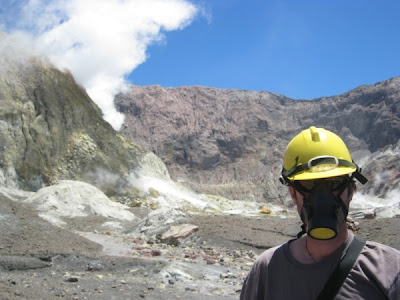
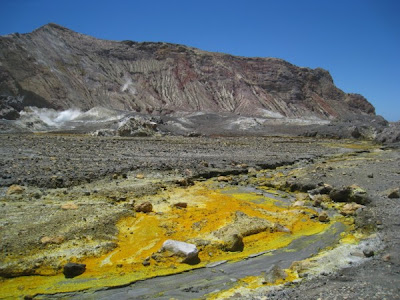
We spent about two hours walking around the crater in a lunar-like landscape. The ground was very very warm underfoot and the noise of steam hissing out of fumaroles, mud bubbling and gas under pressure screaming out of vents made it a very raw and real experience.
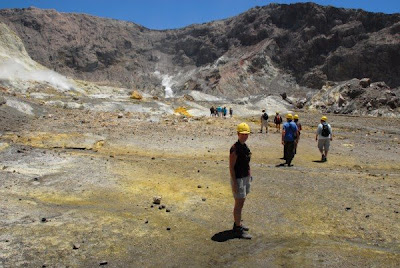
We walked right among the steaming fumaroles,
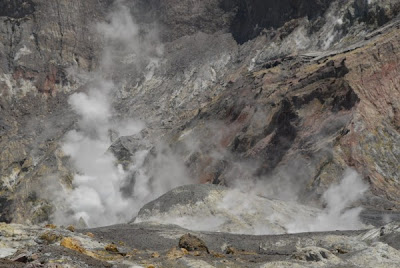
through the hot throat-stinging steam,
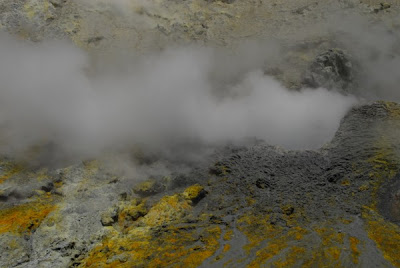
and vibrant yellow sulphur crystals
and looked into pools of bubbling mud when the steam allowed

but at times you just had to shut your eyes and turn or walk away.
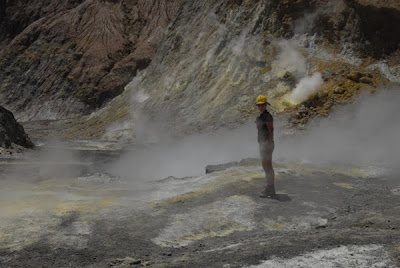
We’d all signed indemnity forms and the guides warned us not to stray off the beaten track but it was very much up to us to keep away from any vents which at times was difficult as they were everywhere! The one behind us in the below made a horrendous noise. Something was under a whole lot of pressure!

NZs volcanoes are part of the pacific ring of fire that runs from the San Andreas fault line in California, through Easter Island, NZ, Indonesia, Japan, the Aleutian Archipelago and back to California. The difference with NZ is that the geothermal activity is hydrothermal, significantly more explosive and powerful. Someone likened mixing magma and lakes as being similar to sticking an intensely hot frying pan under the tap.
This was the best vent and one that had only opened up a few months ago. It was absolutely pumping out the steam and the heat from it certainly made everyone keep their distance. It looked and sounded rather scary and you could hear the bubbling mud deep down inside.
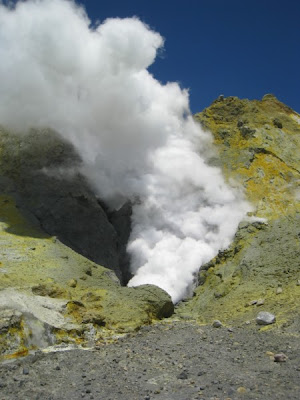
This shot, with the people in it, gives it some scale.
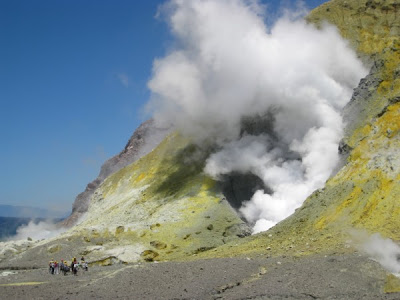
Here is what it looked like in real life. You can see the mud spurting up from the steam and you can just see the big new vent (that's what is making that awful noise) in the right of the video.
The crater lake itself can be a multitude of colours but the day we visited it was a fairly dull green. With a pH of -0.1 and a temperature of 70 degrees C you wouldn’t last long if you fell in. I was struggling with the steam and sulphur fumes and shortly after stuck on my gas mask.

The sulphur crystallised into some wonderful colours and this stream trickled down into the sea
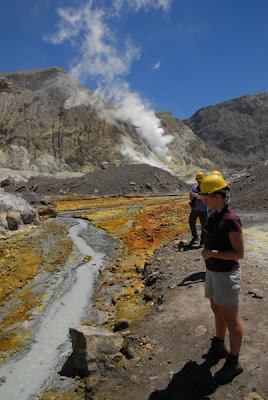
causing the water near the shoreline to turn a light blue and it was noxious so any fish that happened to swim in it died. There were quite a few washed up dead on the beach and being picked at by gulls. One of the crew members fell in but he seemed OK (apart from having the piss ripped out of him by his crew members for the rest of the journey, poor chap).
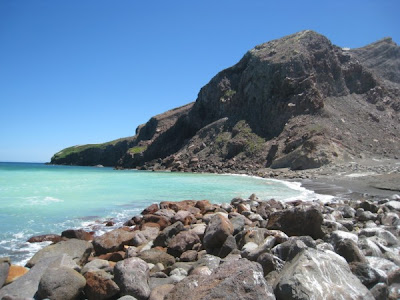
This is the remains of an old sulphur factory, the second one that has been built on the island. The first one was swept away in the 1914 eruption and no traces of the buildings were ever found.
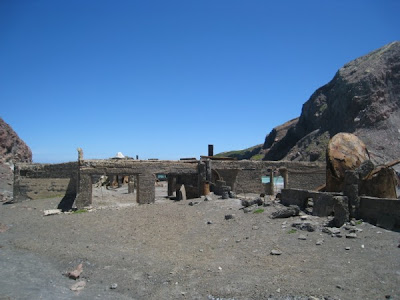
Some of the machinery remains

but the buildings, made out of reinforced concrete (twisted and shattered) and Canadian pine (absolutely smashed to pieces), were wrecked in another eruption in 1933 that saw the end to any mining work done on the island. Apparently only a cat survived the second eruption.
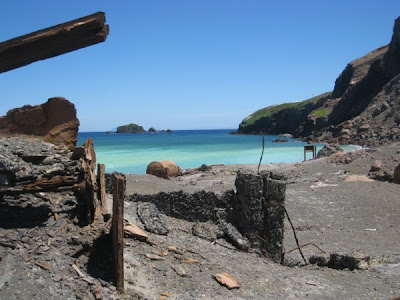
As we motored away we got a different view of the island but you can imagine what it would have been like had the walls not been blown out.
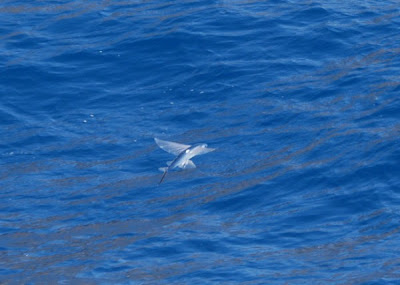
There are loads of fish, particularly some sizable kingfish although fishermen have reported their lead weights melting from the underwater vents. There were also flying fish off the point. Has anyone any idea how difficult it is to photograph these things? They flit up, a flash of silver and blue in amongst a whole mass of blue sea and move so quickly that you don’t know where to focus the camera. Euan has the patience of a saint and gave it a damn good try and below was the best he got. They use their tails as a rudder and propeller and can travel for 100s of metres at a time.
Then we came across a massive pod of dolphins. There were over 100 of them and they surrounded the boat from all sides.
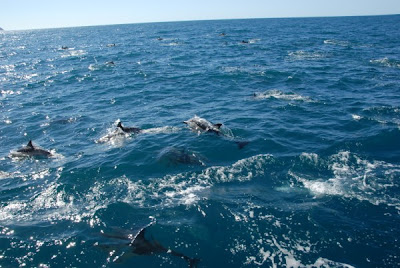
There was a collective gasp from everyone watching as seven of them zoomed out of the water at the same time but its difficult to watch and take photos. They’re so quick and you have to have the camera glued to your face, which dilutes the experience somewhat, so we didn’t quite get the perfect shot.
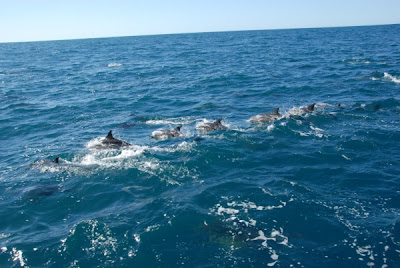
We suddenly had 100s of dolphin photos to join the 100s of steamy, fumaroles photos!


The waves were heading straight into the Whakatane river mouth when we got back and the captain had to hold back then surf the launch into the mouth on a large wave and zoom past the big rocks.
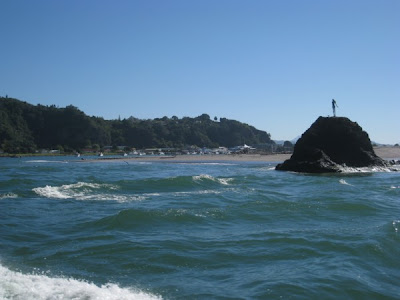
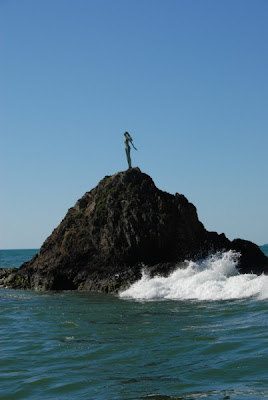
This is the statue of Wairaka, otherwise known as the lady on the rock, at the entrance of the river mouth. There is an old Maori myth behind Wairaka but I won't go into it here.
White Island is a pretty unique place and we’d highly recommend (while taking a big gulp at the price) visiting if you can. It really is a superb experience.


